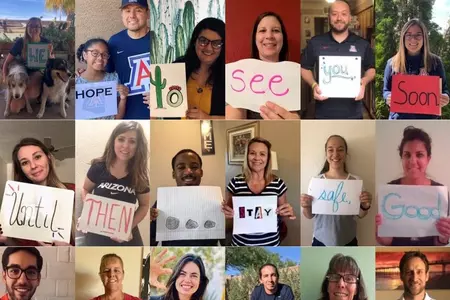
Powering the Return - C.A.T.S. Academics
11/10/2020 | General, C.A.T.S. Academics
In mid-March, operations around McKale Center came to a halt. Seasons were canceled, classes were moved from in-person to online and student-athletes were encouraged to leave campus and return to their hometowns in the face of a global pandemic.
In the next six months, every Arizona Athletics employee answered the call-to-action, navigating uncertain times to do whatever necessary to serve the student-athletes and prepare for a safe and healthy return to campus and, eventually, competition.
There was the immediate challenge of continuing to support student-athletes, keeping them healthy and doing everything possible to continue to provide the support they would be receiving if they were still on campus.
Simultaneously, an incredibly detailed re-entry plan had to be built. The challenge: returning 500 student-athletes to campus and re-integrating them into training and practice regimens while taking every precaution possible to make sure every student-athlete and coach was as safe as possible.
The re-entry planning process was thorough, organized into three phases, with specific operational domains coordinated with each phase. The plan was built, and the re-entry process was initialized.
Many areas in the athletic department have gone well above and beyond their normal job duties in the last six months. Many individuals and departments have overcome unprecedented levels of adversity and moved forward admirably in uncertain times. In this Powering the Return series, we will highlight the work of five departments that have been some of the most influential to our re-entry process; five departments that have gone well above the call of duty.
I. Strength Coaches & Nutrition
II. Medical Trainers (Oct. 20)
III. Mental Health (Oct. 27)
IV. Facilities (Nov. 5)
V. C.A.T.S. Academics (below)
When many student-athletes make the decision to attend the University of Arizona, they do so with the knowledge they will be able to compete on a national stage in athletics and academics. Sure, most fans only see their athletic pursuits on television or social media, but the academic component is one that Arizona takes great pride in.
Enter C.A.T.S. Academics.
Led by Senior Associate A.D. for Student-Athlete Development John Mosbach and Assistant A.D./Director for C.A.T.S. Academics Marisol Quiroz, C.A.T.S Academics provides the necessary services to student-athletes to achieve their academic goals. The extremely talented staff of academic counselors and learning specialists help the student-athletes navigate their way through their academic pursuits.
The areas that provide support to the student-athletes in a variety of ways include academic counselors, learning specialists, assistant learning specialists, tutoring, study halls and content labs.
"In a time of so much uncertainty, it's reassuring for students to have the stabilizing support of the C.A.T.S. Academics staff," Mosbach said. "Their tireless work and adaptability has been a cornerstone in our effort to continue to provide an engaging and positive academic experience for UofA student-athletes as they navigate this unique learning environment."
 And that talented staff was put to the test when the COVID-19 pandemic hit the United States in March as most students were getting ready to head out of town for Spring Break.
In the blink of an eye, all appointments and tutor meetings went from in-person to being done remotely. That's over 7,000 of the nearly 14,000 overall appointments for the Spring 2020 semester that had to be moved online. And now as we near the end of the Fall 2020 semester, another obstacle – Zoom fatigue – is something that everyone is considering. Finding creative ways to make the time spent on Zoom as fun and engaging for each individual student-athlete is a new part of the job for student-athletes and staff.
It's certainly no easy task, but the C.A.T.S Academics staff was up to the challenge.
"Prior to COVID-19, we always had some aspirational goals to explore to experiment with some online services in some form," Quiroz said. "We saw it was happening more on our campus and across the country so it was something that we felt would be a good project for us to work on. But once COVID hit, we had to transfer everything online in a matter of days."
In addition to the full-time staff in C.A.T.S Academics, there are 72 part-time staff that all had to pitch in and learn new ways to do things, all in the name of supporting the students to allow them to continue working towards a college degree.
Part of that support involved assessing the technological needs of the students. Did they have laptops to complete assignments at home? Did they have adequate Wi-Fi options? If the answer was 'No' to either of those, the student-athlete was able to sign out computers or hot spots.
"We have some people on our staff that are very skilled," Quiroz said, "and we are very lucky that we had them on our side. They were so dedicated to figuring out how we could translate our services during a difficult time."
Another aspect of the academic side that was, and still is, changing is the different modalities that classes are being offered. Most classes started the Fall 2020 semester as online only, but as the semester progressed, some shifted to 'Flex In-Person". So that required yet another adjustment from the student-athletes and C.A.T.S. Academics to make sure that the changes did not impact their learning in a negative way. The lines of communication with professors, academic support and the student-athlete are constantly open and evolving.
Those lines of communication for the academic staff included internal communication with coaching staffs and other departments within the athletic department. Everyone involved with each team had to be on the same page to make sure both the academic and athletic priorities were being met by the student-athletes. It truly is a team behind the team that has made everything fall into place one way or another.
 While there were assuredly some bumps along the way, when you step back and look at the bigger picture, it's easy to see that the C.A.T.S. Academics staff excelled. They have helped the department extend its streak of consecutive semesters with at least a 3.0 cumulative GPA among all student-athletes to five.
Recently it was announced that Arizona Athletics continues its steady improvement in Graduation Success Rate (GSR) of student-athletes. Over the last 10 years, Arizona's GSR has improved 20 points, highlighted by most recent announcement of 87 percent.
While the student-athletes undeniably deserve credit for all that they have accomplished in the classroom – virtual or otherwise, that staff in C.A.T.S. Academics also deserve to be recognized for helping push those student-athletes to not settle for less.
"I can't stress enough how awesome our group is," said Quiroz. "I can't say it enough. From academic counselors to learning specialists to tutors to our desk attendants, they all had to change the way they worked. And we haven't had any down time to take a breath and plan ahead. It has just been a lot of great work from a lot of smart and skilled people to get the job done."
But when asked to describe the aspects of those affiliated with C.A.T.S. Academics that she is most proud of, Quiroz doesn't hesitate.
"Their grit, determination and commitment."
Digging a little deeper into one of the many examples of that dedication and commitment to the student-athletes is a pilot program that was launched shortly before the pandemic started.
That program was a book club.
Learning Specialists Mary Hartman and Taylor Stephens initially began discussions on the idea two summers ago and then decided to implement their ideas during the Fall 2019 semester.
The basic idea was to engage students that expressed a desire to enhance their reading and writing skills. The plan was to have the group meeting in person regularly to discuss a book, read chapters aloud during the meeting and talk about the issues from the book.
But once everything moved online as a result of the pandemic, the plan had to shift along with it and become a virtual meeting. Hartman and Stephens quickly adapted and all of the students that volunteered to be part of the group were still on board.
The first book that the group read was about four kids from very different backgrounds trying to come together for a common goal. Their backgrounds shaped how they viewed the same situations differently than their friends.
The student-athletes in the group quickly identified with the characters because that's what college athletics is all about – students from all across the globe joining forces to compete at the highest level.
Part of Book Club involved writing alternative endings to the book and also analyzing why things happened the way they did. It was another way to get the group engaged and expand their ability to put their thoughts in written form.
As the group finished the first book, Hartman and Stephens could notice improvement across the board in all members of the group. They were engaged in each meeting and looked forward to the getting together each week to read what was going to happen next.
That led the group to pick the second book – The Hate U Give by Angie Thomas. The book is a novel based on a short story about the shooting of Oscar Grant. And reading this book coincided with the social justice movement that was and continues to sweep across the country following the death of George Floyd in Minneapolis.
While the group was anxious to discuss the book each week, they also looked forward to each meeting so they could discuss the things that they were seeing on television and social media in the real world. The meetings became a safe place where the group could discuss these sensitive topics and get direct answers from people they trusted.
To a person, all members of Book Club say that the impact they have felt from joining the group has been profound.
Boobie Curry: "I would say that Book Club has meant a lot to me. Miss Hartman and Miss Stephens take the time out of their day each week to educate us and help us progress, not just with reading, but with situations we may encounter in our life."
Keishawn Everly: "I enjoy hearing what other people think about different topics. I like that we talk about politics and I think it's interesting to hear how other people see the world and why they think the way they do."
Jamari Williams: "Book Club gives me a chance to learn and read about things that I might not have the opportunity to without it. Being able to learn in a group setting and discuss things with others that normally would not come up during a regular day is something that I really enjoy."
Eddie Siaumau: "Book Club is a lot of fun. I have learned a lot of things about life in general and things that are going on in the world today. It's fun to get into the books and I can't wait to read the next one."
Myles Tapusoa: "Before I joined Book Club, I struggled at times with comprehension. But the more we read and listen to other people share their insights, it has helped me grow my reading comprehension. I also like that the books we read have real life situations that we see in our daily lives. It's interesting to go through our day and see these things happen but we have different perspectives. That's why I like Book Club.
Jamarye Joiner: "Book Club has helped me a lot with my reading comprehension. I've learned how to understand what I'm reading and how to read it so I can comprehend it. And I like the discussions that we have. We talk about controversial topics and that's not something that everyone is willing to do. It's really eye-opening to have those conversations and I think we all benefit from that."
In the next six months, every Arizona Athletics employee answered the call-to-action, navigating uncertain times to do whatever necessary to serve the student-athletes and prepare for a safe and healthy return to campus and, eventually, competition.
There was the immediate challenge of continuing to support student-athletes, keeping them healthy and doing everything possible to continue to provide the support they would be receiving if they were still on campus.
Simultaneously, an incredibly detailed re-entry plan had to be built. The challenge: returning 500 student-athletes to campus and re-integrating them into training and practice regimens while taking every precaution possible to make sure every student-athlete and coach was as safe as possible.
The re-entry planning process was thorough, organized into three phases, with specific operational domains coordinated with each phase. The plan was built, and the re-entry process was initialized.
Many areas in the athletic department have gone well above and beyond their normal job duties in the last six months. Many individuals and departments have overcome unprecedented levels of adversity and moved forward admirably in uncertain times. In this Powering the Return series, we will highlight the work of five departments that have been some of the most influential to our re-entry process; five departments that have gone well above the call of duty.
I. Strength Coaches & Nutrition
II. Medical Trainers (Oct. 20)
III. Mental Health (Oct. 27)
IV. Facilities (Nov. 5)
V. C.A.T.S. Academics (below)
When many student-athletes make the decision to attend the University of Arizona, they do so with the knowledge they will be able to compete on a national stage in athletics and academics. Sure, most fans only see their athletic pursuits on television or social media, but the academic component is one that Arizona takes great pride in.
Enter C.A.T.S. Academics.
Led by Senior Associate A.D. for Student-Athlete Development John Mosbach and Assistant A.D./Director for C.A.T.S. Academics Marisol Quiroz, C.A.T.S Academics provides the necessary services to student-athletes to achieve their academic goals. The extremely talented staff of academic counselors and learning specialists help the student-athletes navigate their way through their academic pursuits.
The areas that provide support to the student-athletes in a variety of ways include academic counselors, learning specialists, assistant learning specialists, tutoring, study halls and content labs.
"In a time of so much uncertainty, it's reassuring for students to have the stabilizing support of the C.A.T.S. Academics staff," Mosbach said. "Their tireless work and adaptability has been a cornerstone in our effort to continue to provide an engaging and positive academic experience for UofA student-athletes as they navigate this unique learning environment."
And that talented staff was put to the test when the COVID-19 pandemic hit the United States in March as most students were getting ready to head out of town for Spring Break.In the blink of an eye, all appointments and tutor meetings went from in-person to being done remotely. That's over 7,000 of the nearly 14,000 overall appointments for the Spring 2020 semester that had to be moved online. And now as we near the end of the Fall 2020 semester, another obstacle – Zoom fatigue – is something that everyone is considering. Finding creative ways to make the time spent on Zoom as fun and engaging for each individual student-athlete is a new part of the job for student-athletes and staff.
It's certainly no easy task, but the C.A.T.S Academics staff was up to the challenge.
"Prior to COVID-19, we always had some aspirational goals to explore to experiment with some online services in some form," Quiroz said. "We saw it was happening more on our campus and across the country so it was something that we felt would be a good project for us to work on. But once COVID hit, we had to transfer everything online in a matter of days."
In addition to the full-time staff in C.A.T.S Academics, there are 72 part-time staff that all had to pitch in and learn new ways to do things, all in the name of supporting the students to allow them to continue working towards a college degree.
Part of that support involved assessing the technological needs of the students. Did they have laptops to complete assignments at home? Did they have adequate Wi-Fi options? If the answer was 'No' to either of those, the student-athlete was able to sign out computers or hot spots.
"We have some people on our staff that are very skilled," Quiroz said, "and we are very lucky that we had them on our side. They were so dedicated to figuring out how we could translate our services during a difficult time."
Another aspect of the academic side that was, and still is, changing is the different modalities that classes are being offered. Most classes started the Fall 2020 semester as online only, but as the semester progressed, some shifted to 'Flex In-Person". So that required yet another adjustment from the student-athletes and C.A.T.S. Academics to make sure that the changes did not impact their learning in a negative way. The lines of communication with professors, academic support and the student-athlete are constantly open and evolving.
Those lines of communication for the academic staff included internal communication with coaching staffs and other departments within the athletic department. Everyone involved with each team had to be on the same page to make sure both the academic and athletic priorities were being met by the student-athletes. It truly is a team behind the team that has made everything fall into place one way or another.
While there were assuredly some bumps along the way, when you step back and look at the bigger picture, it's easy to see that the C.A.T.S. Academics staff excelled. They have helped the department extend its streak of consecutive semesters with at least a 3.0 cumulative GPA among all student-athletes to five.Recently it was announced that Arizona Athletics continues its steady improvement in Graduation Success Rate (GSR) of student-athletes. Over the last 10 years, Arizona's GSR has improved 20 points, highlighted by most recent announcement of 87 percent.
While the student-athletes undeniably deserve credit for all that they have accomplished in the classroom – virtual or otherwise, that staff in C.A.T.S. Academics also deserve to be recognized for helping push those student-athletes to not settle for less.
"I can't stress enough how awesome our group is," said Quiroz. "I can't say it enough. From academic counselors to learning specialists to tutors to our desk attendants, they all had to change the way they worked. And we haven't had any down time to take a breath and plan ahead. It has just been a lot of great work from a lot of smart and skilled people to get the job done."
But when asked to describe the aspects of those affiliated with C.A.T.S. Academics that she is most proud of, Quiroz doesn't hesitate.
"Their grit, determination and commitment."
Digging a little deeper into one of the many examples of that dedication and commitment to the student-athletes is a pilot program that was launched shortly before the pandemic started.
That program was a book club.
Learning Specialists Mary Hartman and Taylor Stephens initially began discussions on the idea two summers ago and then decided to implement their ideas during the Fall 2019 semester.
The basic idea was to engage students that expressed a desire to enhance their reading and writing skills. The plan was to have the group meeting in person regularly to discuss a book, read chapters aloud during the meeting and talk about the issues from the book.
But once everything moved online as a result of the pandemic, the plan had to shift along with it and become a virtual meeting. Hartman and Stephens quickly adapted and all of the students that volunteered to be part of the group were still on board.
The first book that the group read was about four kids from very different backgrounds trying to come together for a common goal. Their backgrounds shaped how they viewed the same situations differently than their friends.
The student-athletes in the group quickly identified with the characters because that's what college athletics is all about – students from all across the globe joining forces to compete at the highest level.
Part of Book Club involved writing alternative endings to the book and also analyzing why things happened the way they did. It was another way to get the group engaged and expand their ability to put their thoughts in written form.
As the group finished the first book, Hartman and Stephens could notice improvement across the board in all members of the group. They were engaged in each meeting and looked forward to the getting together each week to read what was going to happen next.
That led the group to pick the second book – The Hate U Give by Angie Thomas. The book is a novel based on a short story about the shooting of Oscar Grant. And reading this book coincided with the social justice movement that was and continues to sweep across the country following the death of George Floyd in Minneapolis.
While the group was anxious to discuss the book each week, they also looked forward to each meeting so they could discuss the things that they were seeing on television and social media in the real world. The meetings became a safe place where the group could discuss these sensitive topics and get direct answers from people they trusted.
To a person, all members of Book Club say that the impact they have felt from joining the group has been profound.
Boobie Curry: "I would say that Book Club has meant a lot to me. Miss Hartman and Miss Stephens take the time out of their day each week to educate us and help us progress, not just with reading, but with situations we may encounter in our life."
Keishawn Everly: "I enjoy hearing what other people think about different topics. I like that we talk about politics and I think it's interesting to hear how other people see the world and why they think the way they do."
Jamari Williams: "Book Club gives me a chance to learn and read about things that I might not have the opportunity to without it. Being able to learn in a group setting and discuss things with others that normally would not come up during a regular day is something that I really enjoy."
Eddie Siaumau: "Book Club is a lot of fun. I have learned a lot of things about life in general and things that are going on in the world today. It's fun to get into the books and I can't wait to read the next one."
Myles Tapusoa: "Before I joined Book Club, I struggled at times with comprehension. But the more we read and listen to other people share their insights, it has helped me grow my reading comprehension. I also like that the books we read have real life situations that we see in our daily lives. It's interesting to go through our day and see these things happen but we have different perspectives. That's why I like Book Club.
Jamarye Joiner: "Book Club has helped me a lot with my reading comprehension. I've learned how to understand what I'm reading and how to read it so I can comprehend it. And I like the discussions that we have. We talk about controversial topics and that's not something that everyone is willing to do. It's really eye-opening to have those conversations and I think we all benefit from that."


Friday, September 04
Wednesday, September 02
Wednesday, September 02
Wednesday, September 02